Liminalita is a 3D procedural art walking simulator I started designing after Procjam 2021. It was directly inspired by an entry from that jam called I Don’t Get It—a minimalist walking simulator in a single looping room that stuck with me long after I closed it.
I wanted to explore those ideas more deeply. I’ve always been drawn to that feeling of wandering in a space that’s coherent but impossible—something Antichamber did masterfully. Rooms that change behind you, stairs that lead nowhere, and floors that don’t act like floors. I wanted Liminalita to live in that same spirit of unreality—less of a game, more of a space you fall into.
---
Tools & Origins
A few months before starting Liminalita, I picked up Godot for the first time. I used to write Crystal bindings for the raylib library, so game development wasn’t totally new to me, but 3D space, shaders, and Godot’s scene system were all new territory. Still, Godot made it possible to build this project the way I imagined it.
Early on, I attempted to implement an outline shader for stylized edges. I wanted crisp outlines from far away, but the shader broke down at distance. Someone shared a base for it, which I modified and customized to fit our low-poly rendering pipeline.
---
Building the Gallery
The game started with a gallery-style lobby area, which has grown into a procedural museum containing several distinct exhibits:
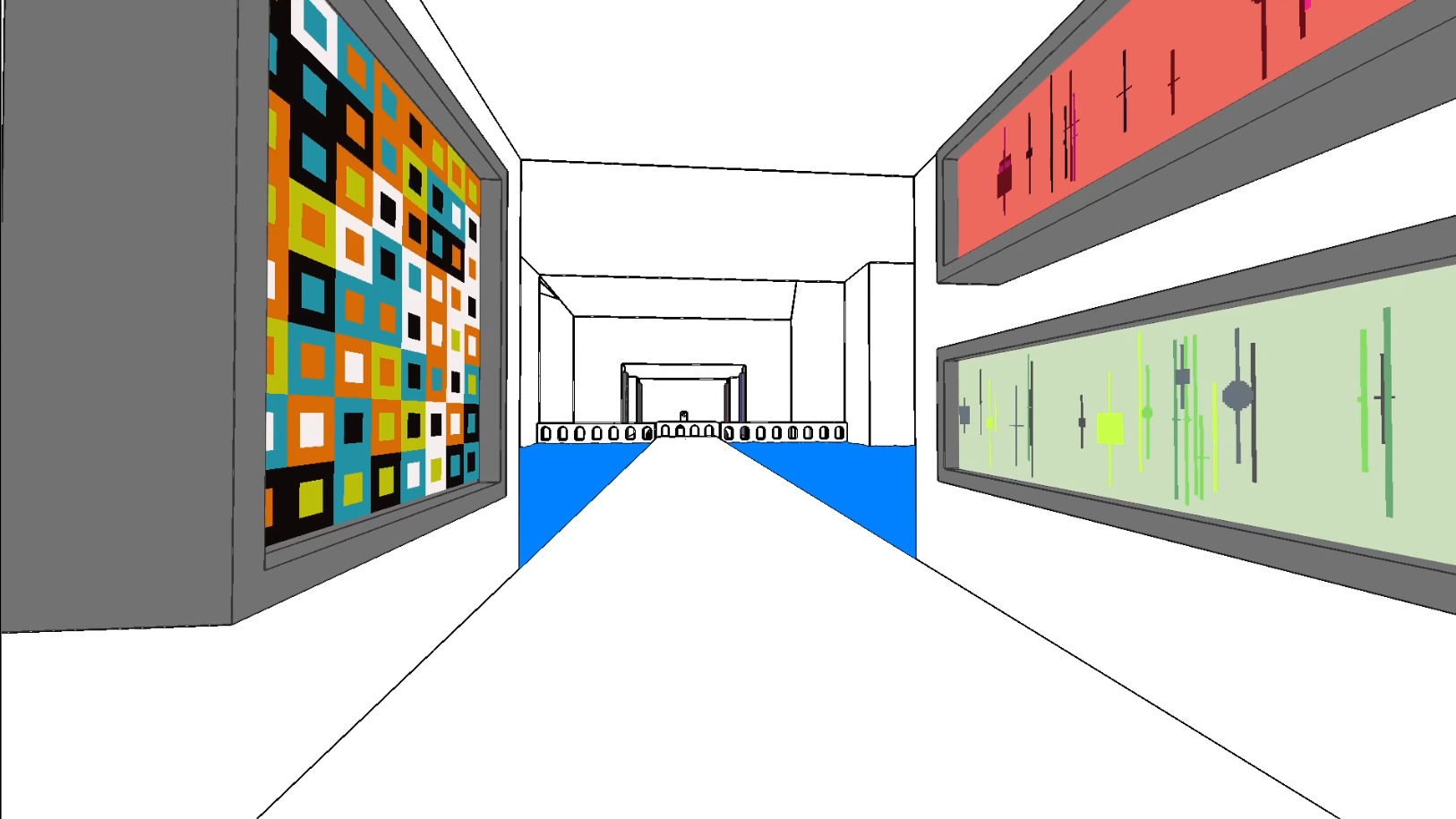
- Free Exhibit Tour: A walkable path with procedural paintings, statue rooms, and a small garden—a warm-up to the stranger spaces ahead.
- Infinite Exhibit: A square hallway loop that folds in on itself, where paintings subtly shift as you walk. You cannot escape until you turn around and walk back the way you came.
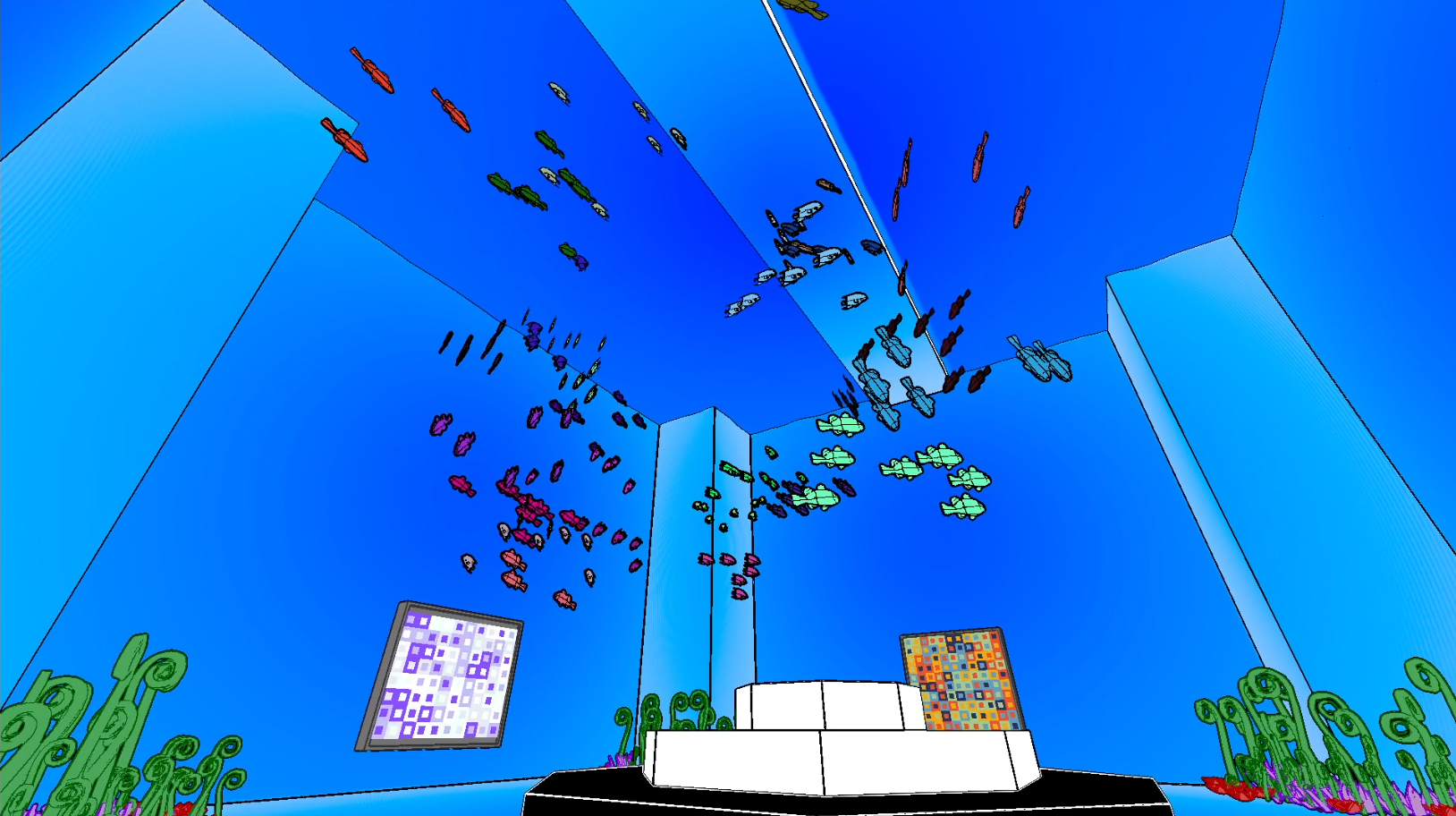
- Aquarium Exhibit: A custom water shader creates an immersive underwater gallery. Players fall into the tank and walk among procedurally generated schools of fish. The effect duplicates and offsets an animated fish model along smooth paths with randomized progress.
---
Spatial Tricks and Illusions
Liminalita is full of intentional mind games and geometric anomalies:
- The Atrium Room: As you ascend to the second level, you are quietly teleported back to the ground floor. The illusion is preserved because the room resets out of sight, creating a seamless glitch in spatial logic.
- The Hilbert Hotel: Inspired by Hilbert’s Infinite Hotel paradox, this is an infinite vertical space where each floor is procedurally generated as you descend. When the player leaves the lobby and looks away, the staircase shifts downward to reveal endless new floors.
Some floors utilize a 3D tilemap mixing randomized layout chunks. Other floors are handcrafted, such as a motel courtyard complete with a swimming pool. * An elevator on every floor allows players to return to the lobby at any time.
---
Development Videos
I have been documenting the build process in a YouTube devlog series: Devlog Playlist – Liminalita
---
Liminalita isn’t a game about winning or solving puzzles. It’s about walking, witnessing, and feeling off-kilter in a space where the rules bend and walls rearrange when you aren't looking.
Thanks for following along. — sol.vin